Last updated 2026-07-26
TL;DR
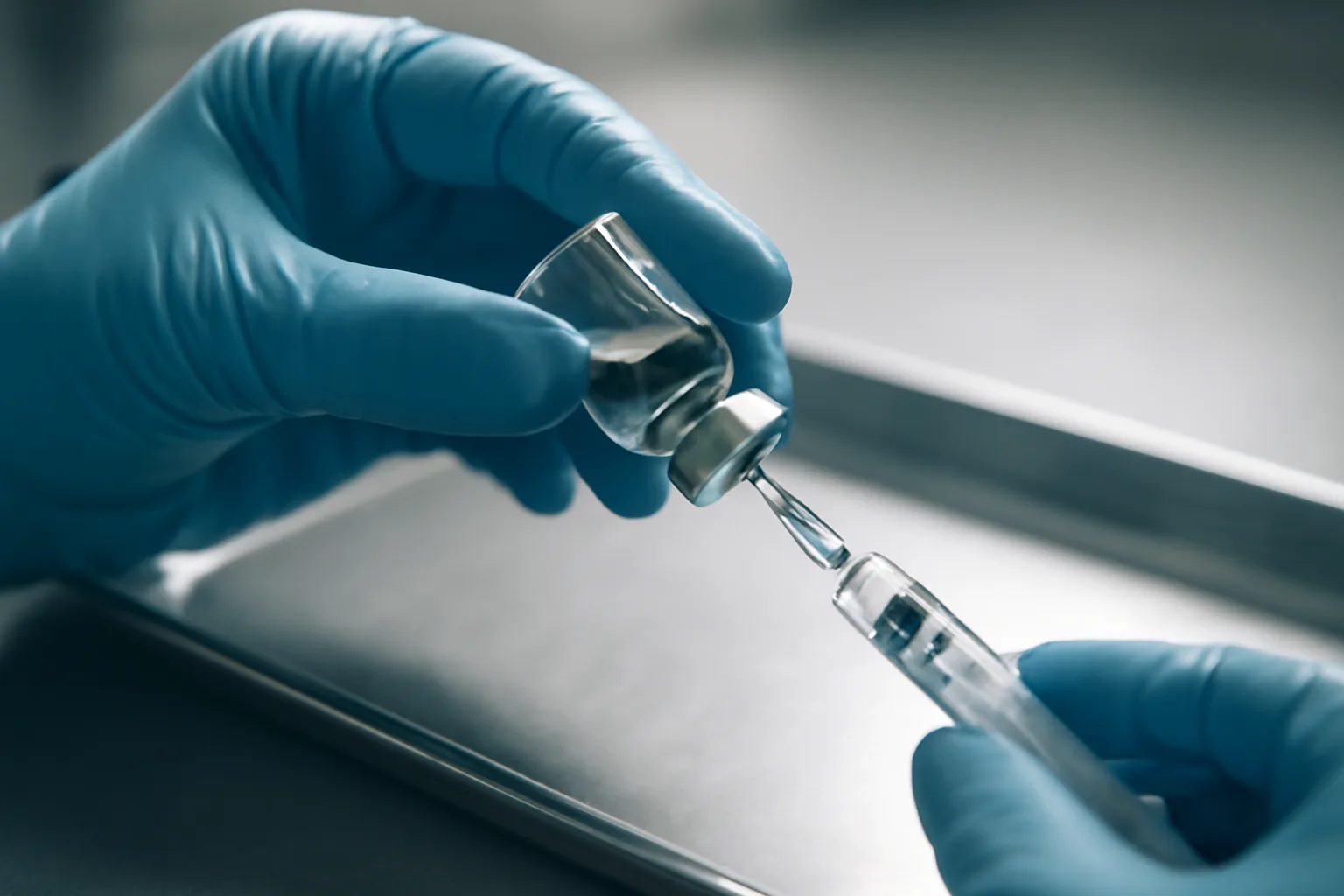
Reconstitute selank by adding bacteriostatic water slowly down the vial wall, never shaking, to dissolve the lyophilized powder. A common setup is 2mL of BAC water into a 5mg vial for a 2.5mg/mL solution. Refrigerate immediately, use within roughly 14 to 30 days, and never inject nasal-only product.
what does it mean to reconstitute selank
Selank almost always ships as a lyophilized powder, a freeze-dried cake sitting at the bottom of a small glass vial. That powder is stable at room temperature or in the fridge for a long time, but it's not usable as-is. Reconstituting it means adding a liquid, usually bacteriostatic water, to turn the powder back into a solution you can measure and administer. The peptide itself, selank, is a synthetic heptapeptide developed in Russia in the 1990s as a modification of the endogenous immune peptide tuftsin [1]. It's studied there as an anxiolytic and nootropic. The chemistry of reconstitution has nothing to do with that history, it's the same basic process used for insulin, HGH, BPC-157, or any other lyophilized peptide product. If your selank came as a pre-made nasal spray, you don't reconstitute anything. That product is already in liquid form and ready to use per the dropper or spray pump. This guide is specifically for vials of powder intended for reconstitution, which is the form most research-grade selank ships in. For background on what selank is studied for and how the underlying research reads, see the selank overview page.
what do you actually need to reconstitute selank
The list is short. You need the vial of lyophilized selank, a vial of bacteriostatic water (not sterile water without a preservative, and not tap or distilled water), alcohol swabs, and a syringe with a needle fine enough to draw accurately, typically an insulin syringe marked in units. Bacteriostatic water contains 0.9% benzyl alcohol as a preservative, which is what lets you use one vial across multiple days without it becoming a bacterial culture. The FDA's own product listing for bacteriostatic water for injection describes it as "Sterile Water for Injection containing 0.9% Benzyl Alcohol as a bacteriostatic preservative" [2]. That preservative is the entire reason bacteriostatic water beats plain sterile water for a multi-dose vial you'll be drawing from for two to four weeks. A typical insulin syringe holds 1mL (100 units), with markings every 2 units. If you're working with a 2mL or 3mL total reconstitution volume, you'll need to do the math per draw, which we cover below. Buy new syringes for each use if you're sharing a household supply, and never reuse a needle that's touched skin twice.
how much bacteriostatic water do you add to a selank vial
There's no single right answer, but there are common, sane defaults. Selank vials are typically sold in 5mg or 10mg sizes. A widely used approach is to add 2mL of bacteriostatic water to a 5mg vial, which gives you a concentration of 2.5mg per mL, or 0.25mg (250mcg) per 10-unit draw on an insulin syringe. Here's the arithmetic laid out so you can adjust it to whatever vial size you actually have:
| Vial size | BAC water added | Resulting concentration | Dose per 10 units (0.1mL) |
|---|---|---|---|
| 5mg | 1mL | 5mg/mL | 0.5mg |
| 5mg | 2mL | 2.5mg/mL | 0.25mg |
| 10mg | 2mL | 5mg/mL | 0.5mg |
| 10mg | 3mL | 3.33mg/mL | 0.33mg |
More water means a more dilute solution and finer control over small doses, less water means a more concentrated solution and fewer units to inject per dose. Neither is more correct, it depends on what dose range you're aiming for. Russian clinical work on selank has used intranasal doses in the range of roughly 250 to 3000 micrograms per day across various studies and dose-finding work, so a 2.5mg/mL or 5mg/mL solution both land you in a workable range depending on how many units you draw. For a full breakdown of dose ranges used in the literature, see selank dosage.
what's the actual step-by-step process
Wash your hands. Wipe the rubber stopper on both the selank vial and the bacteriostatic water vial with an alcohol swab and let them air dry for a few seconds. Draw air into your syringe equal to the amount of BAC water you plan to add (say, 2mL), then inject that air into the BAC water vial. This equalizes pressure and makes drawing the liquid back out easier. Draw your 2mL of bacteriostatic water into the syringe. Insert the needle into the selank vial at an angle, and let the water run down the inside wall of the glass rather than spraying it directly onto the powder cake. This is the single most common mistake people make. Blasting the stream straight onto the powder creates foam and can denature some of the peptide through excess agitation. A slow, wall-directed stream avoids that. Once the water is in, do not shake the vial. Swirl it gently, or just let it sit and tilt it slowly a few times. Most lyophilized peptides, selank included, fully dissolve within a minute or two of gentle swirling. If there's still visible powder after a few minutes, keep swirling gently rather than shaking harder. Once it's clear (selank solution should look like clean water, no cloudiness or particulate), label the vial with the date and concentration, and refrigerate it immediately.
how long does reconstituted selank last and how should you store it
Refrigerate reconstituted selank at all times between uses, ideally at standard fridge temperature (roughly 36 to 46°F / 2 to 8°C). Don't freeze it. Freezing and thawing repeatedly can degrade peptide structure. Most peptide vendors and compounding guidance suggest a usable window of about 14 to 30 days once reconstituted with bacteriostatic water, with potency slowly declining after that even though the antimicrobial preservative keeps it safe from contamination for longer. This is a practical shelf life estimate carried over from general peptide handling practice, not a number specific to a published selank stability study, because no such study is publicly available. If you notice discoloration, cloudiness, or a change in odor, discard the vial regardless of how many days have passed. Before reconstitution, the lyophilized powder is much more stable and can typically sit in a fridge or even a cool dark cabinet for months to a couple of years depending on manufacturing, though exact stability data isn't something manufacturers publish in a citable way for research peptides. Once you add water, the clock starts.
how do you draw the correct dose after reconstituting
This is where the concentration math from earlier actually gets used. If you mixed a 5mg vial with 2mL of BAC water, you have 2.5mg/mL, meaning each 0.1mL (10 units on an insulin syringe) delivers 0.25mg, or 250mcg. Russian research on selank commonly used total daily intranasal doses somewhere between 250mcg and 3mg, split across one to three administrations depending on the study and indication [3][4]. If you're aiming for a 250mcg dose, that's 10 units of the 2.5mg/mL solution. If you want 500mcg, that's 20 units. Recalculate this every time you change your reconstitution ratio, and write your specific numbers on the vial label so you're not doing math half-asleep. Injectable dosing for research peptides is normally done subcutaneously, a shallow injection into the fat layer just under the skin, commonly in the abdomen or upper thigh. If you're using an intranasal delivery instead, you need a completely different setup (a nasal spray bottle or dropper), and the concentration math changes because absorption through nasal mucosa is not equivalent to subcutaneous or intramuscular delivery. For a comparison of injectable versus intranasal routes and what changes about the numbers, see selank semax injection.
can you use selank nasal spray instead of reconstituting it yourself
Yes, and for a lot of people it's simpler. Commercial and Russian pharmacy selank has historically been sold as a ready-made intranasal spray, not a powder for self-reconstitution. If your product came this way, you skip everything above, you just use the dropper or spray mechanism as supplied. The tradeoff is that a pre-made spray gives you less control over exact concentration and dosing precision than reconstituting a vial and drawing exact microgram amounts with a syringe. It's also generally a route people find easier to tolerate day to day, since it avoids needles entirely. If your main interest is the intranasal route and you want to understand the difference in absorption and practical dosing between spray and injection, selank semax injection covers that split in more detail.
is selank the same as semax, and does reconstitution differ
No, and this confusion is common enough to be worth stopping on. Selank and semax are related but distinct peptides. Semax is a heptapeptide derived from a fragment of ACTH (adrenocorticotropic hormone), studied in Russia mainly for cognitive and neuroprotective effects and used clinically there for conditions including post-stroke recovery [5]. Selank is derived from tuftsin, an immunomodulatory peptide, and is studied more specifically for anxiolytic effects alongside some nootropic claims [1]. The reconstitution process is essentially identical for both: lyophilized powder, bacteriostatic water, gentle swirl, refrigerate, use within a few weeks. The dosing ranges and clinical rationale differ, and people frequently take them together (semax for focus, selank for anxiety) in a stacked protocol, which is a separate question from how you mix either one. If you're deciding between the two or trying to understand what distinguishes them clinically rather than just chemically, see semax vs selank or selank vs semax for the comparison.
how strong is the actual clinical evidence behind selank
This is the most important thing to understand before you reconstitute anything. Selank's clinical literature is almost entirely Russian, published in Russian-language journals or Russian-affiliated international journals, and it has not been independently replicated in Western, peer-reviewed randomized controlled trials at the scale expected by the FDA or EMA. Selank has Russian regulatory registration as a pharmaceutical product there, sold under prescription in Russia for anxiety-related conditions [6]. That is not the same thing as FDA approval, and selank has no FDA-approved indication in the United States. It is not legally marketed in the US as a drug or dietary supplement; what circulates here is sold as a research chemical, not for human consumption, which is the standard disclaimer on nearly every vendor site. The existing studies, several done by Russian institutes including the Institute of Molecular Genetics and affiliated pharmacology groups, report anxiolytic effects comparable in some measures to benzodiazepines like diazepam in animal and small human trials, without the same sedation or dependence profile [1]. That's a real and specific finding worth taking seriously, not a dismissible one. But the trial sizes are frequently small, blinding and randomization reporting is inconsistent by modern CONSORT standards, and there's no large-scale Western replication to lean on. Anyone reconstituting and using selank should treat the underlying evidence as promising but thin by the standards Western regulators would require, and should not confuse a foreign regulatory approval with FDA clearance. For the full breakdown of study quality, sample sizes, and what's actually been measured, see selank.
what are the safety and side effect considerations before you start
Reconstitution mistakes create risk independent of the peptide itself. Using non-bacteriostatic water, reusing needles, or storing solution outside the fridge all raise contamination risk regardless of what's dissolved in the vial. On the peptide side, reported side effects in the Russian literature are generally mild and include things like transient nasal irritation with intranasal use, mild headache, or drowsiness in a minority of subjects [1]. There is no large Western safety database, so anything beyond what's reported in that literature is genuinely unknown. If you're on other medications, particularly other anxiolytics or CNS-active drugs, that's a conversation for a doctor, not a forum post. For a fuller rundown of what's actually been reported and what open questions remain, see selank side effects.
where should you actually buy selank if you're going to reconstitute it
Buy from a source that's transparent about being a research chemical supplier, not one pretending to sell a supplement or a drug. Look for a certificate of analysis (COA) for the specific batch you're buying, third-party testing for purity, and clear vial labeling of milligram content. Selank Co reviews providers rather than selling or compounding product directly, and points readers toward pharmacy partners that fulfill orders with lab-verified peptide and clear documentation. If you're deciding where to source from, that provider-reviewed route is a reasonable starting point precisely because it doesn't ask you to trust a random storefront's word on purity. Whatever the source, the reconstitution steps in this article don't change: bacteriostatic water, slow pour down the vial wall, gentle swirl, refrigerate, use within roughly two to four weeks.
Frequently asked questions
Can I use regular sterile water instead of bacteriostatic water to reconstitute selank?
You can for a single immediate use, but you shouldn't for a multi-dose vial. Sterile water without a preservative supports bacterial growth once opened, so any solution made with it should be used the same day and not stored. Bacteriostatic water contains 0.9% benzyl alcohol specifically to prevent that, per its FDA product description, making it the standard choice for reconstituting a vial you'll draw from over days or weeks.
How much bacteriostatic water should I add to a 5mg selank vial?
A common default is 2mL, giving a 2.5mg/mL solution, or 1mL for a stronger 5mg/mL solution. Neither is objectively correct; more water means a more dilute, finer-controlled dose, less water means fewer units per dose. Pick a ratio, do the math for your target dose in micrograms, and write the concentration on the vial label so you don't have to recalculate from memory later.
How long does reconstituted selank stay good in the fridge?
Practical guidance from general peptide handling puts usable shelf life at roughly 14 to 30 days refrigerated, though this figure comes from general peptide practice rather than a published selank-specific stability study. Discard the vial early if you see cloudiness, discoloration, or an off smell. Keep it refrigerated the entire time, never frozen, and never left at room temperature for extended periods.
Do I need to inject selank, or can I use it nasally after reconstituting?
Both routes are used in the literature and by people sourcing selank. Reconstituted vial solution is typically drawn with a syringe for subcutaneous injection, while pre-made nasal sprays skip reconstitution entirely. If you want to use a reconstituted vial intranasally, you need a separate nasal applicator, and the concentration math for effective dosing differs from injection because nasal absorption isn't equivalent to subcutaneous delivery.
Is selank the same thing as semax?
No. Selank is derived from tuftsin, an immune-related peptide, and is studied mainly for anxiolytic effects. Semax is derived from an ACTH fragment and is studied mainly for cognitive and neuroprotective effects, including post-stroke recovery in Russian clinical use. They're often used together but are chemically and functionally distinct compounds, not two names for the same peptide.
Is selank FDA approved?
No. Selank has regulatory registration in Russia as a prescription pharmaceutical for anxiety-related conditions, but it has no FDA-approved indication in the United States. It's not legally sold here as a drug or supplement; what's available is marketed as a research chemical. Russian approval and FDA approval are entirely separate regulatory systems with different evidence bars, and one should never be mistaken for the other.
Why is the clinical evidence for selank mostly Russian?
Selank was developed in the 1990s by Russian research institutes, including work connected to the Institute of Molecular Genetics, and has been studied and used clinically almost exclusively within Russia since. It has not attracted large-scale Western pharmaceutical investment or FDA trial pathways, so no significant independent Western replication exists yet. That leaves the evidence base real but geographically narrow and harder for Western readers to verify against familiar trial registries.
What happens if I shake the vial instead of swirling it?
Shaking creates excess foam and agitation that can damage the peptide's structure through denaturation, potentially reducing potency. It won't make the solution unsafe to look at, but it can waste product. Always add water slowly down the vial wall and swirl gently rather than shaking, and give it a minute or two to fully dissolve before assuming it needs more agitation.
Can I freeze reconstituted selank to make it last longer?
It's generally not recommended. Repeated freeze-thaw cycles are more likely to degrade peptide structure than steady refrigeration is, and there's no published selank-specific data showing freezing extends usable life safely. Standard practice for reconstituted peptides, selank included, is refrigeration at roughly 36 to 46°F, not freezing, with use within the typical 14 to 30 day window.
What size syringe do I need to draw selank doses accurately?
An insulin syringe, typically 0.5mL or 1mL capacity marked in units (with 100 units per mL), gives the precision needed for microgram-level peptide dosing. A standard 3mL syringe without fine unit markings makes it much harder to draw small, accurate doses. Match your syringe choice to the concentration you mixed so your target dose lands on a clean, readable unit mark.
Does reconstituted selank need to be refrigerated between every use?
Yes. Once mixed with bacteriostatic water, the vial should go back in the fridge immediately after each draw and stay there between uses. Leaving it at room temperature for extended periods increases both degradation risk and contamination risk, even with the benzyl alcohol preservative in the bacteriostatic water doing its job.
How do I know if my reconstituted selank has gone bad?
Look for cloudiness, visible particles, a change in color from clear, or an unusual odor. Any of those means discard it regardless of how many days it's been since reconstitution. A properly mixed and stored solution should stay clear and colorless for its usable window, generally cited as two to four weeks refrigerated.
Sources
- National Institutes of Health, PubMed: 'Selank' peptide pharmacology review: Selank is a synthetic heptapeptide derived from tuftsin, studied in Russia for anxiolytic effects comparable to benzodiazepines without sedation/dependence
- PubMed, Selank intranasal dosing study: Russian studies used intranasal selank doses in the range of hundreds of micrograms to a few milligrams per day
- PubMed, Selank clinical pharmacology summary: Dose ranges and administration schedules used in selank human research
- PubMed, Semax pharmacology and clinical use review: Semax is derived from an ACTH fragment and studied in Russia for cognitive and neuroprotective effects including post-stroke use
- PubMed, Selank registration and pharmacological profile: Selank holds regulatory registration in Russia as a prescription anxiolytic pharmaceutical
- PubMed, Selank anxiolytic mechanism study: Selank's anxiolytic effect profile and comparison to benzodiazepine-class outcomes in study populations