Last updated 2026-07-26
TL;DR
Selank is typically injected subcutaneously (under the skin, usually in the abdomen) at 250-3000 mcg per dose, once or twice a day, using an insulin syringe after reconstituting lyophilized powder with bacteriostatic water. Most of the supporting research is Russian, small, and not replicated in Western trials, so treat dosing conventions as community practice, not FDA-established protocol.
What is Selank and how is it normally administered?
Selank is a synthetic heptapeptide, a lab-made copy of tuftsin with some amino acid substitutions, developed in Russia at the Institute of Molecular Genetics and studied since the late 1990s as an anxiolytic and cognitive aid [1]. It's not approved by the FDA for any use in the United States. In Russia it's registered as a prescription nasal spray under the brand Selank, sold in pharmacies for anxiety-related conditions. Outside Russia, Selank is sold almost exclusively as a lyophilized (freeze-dried) powder in vials, intended for research use, and people who use it for personal purposes usually reconstitute it and inject it subcutaneously rather than using a nasal spray. That's a real difference from how the Russian clinical literature dosed it, and it matters: the studies behind Selank's reputation used intranasal delivery, not injections [2]. Injection is a workaround born out of what's actually sold in the gray market, not a route validated by the original research. So when people ask how to inject Selank, they're really asking about a home practice that grew up around a product that was clinically tested a different way. That's worth sitting with before you draw up a syringe. For general background on the peptide, the selank overview page covers the mechanism and evidence base in more depth.
Is Selank injected subcutaneously or intramuscularly?
Nearly everyone using injectable Selank uses the subcutaneous (SubQ) route, not intramuscular. Subcutaneous means the needle goes into the fat layer just under the skin, not into muscle. This is the same injection depth used for insulin and many peptide compounds, and it's why insulin syringes (with short, thin needles, typically 29-31 gauge, 4-8mm long) are the standard tool. Intramuscular injection is deeper, hurts more without training, and there's no data suggesting it improves absorption or effect for a peptide like this. Nobody in the Russian trials used IM or SubQ injection at all, they used nasal spray, so there's no clinical comparison to lean on. Subcutaneous is simply the practical convention that emerged because it's the easiest injection route to self-administer safely and it's how most peptides of similar size are handled. Common injection sites are the abdomen (at least 2 inches from the navel), the outer thigh, or the back of the upper arm if someone else is giving the shot. Rotating sites reduces local irritation and the small risk of lipohypertrophy (fatty lumps under the skin from repeated injections in the same spot), a well-documented issue in insulin-injecting diabetics that applies to any repeated SubQ injection [3].
How do you reconstitute Selank powder before injecting it?
Selank typically comes as a lyophilized powder in a 5mg or 10mg vial. You reconstitute it by adding bacteriostatic water (sterile water with 0.9% benzyl alcohol as a preservative) directly into the vial. Bacteriostatic water is what's used because it inhibits bacterial growth, letting a reconstituted vial last longer in the fridge, generally cited as up to 2-4 weeks when refrigerated, though there's no published stability study on Selank specifically dictating that number, it's an extrapolation from general peptide reconstitution practice. For a 10mg vial, a common approach is to add 2mL of bacteriostatic water, which gives a concentration of 5mg/mL, or 5000mcg/mL. At that concentration, 0.1mL (10 units on an insulin syringe) equals 500mcg. If you add 1mL instead, you double the concentration to 10mg/mL, meaning 0.1mL equals 1000mcg, and your syringe markings mean something different. Getting this math right before you draw anything up matters more than almost any other step, because a mistake here is a dosing mistake, not a technique mistake. Inject the bacteriostatic water slowly down the side of the vial, don't shoot it directly at the powder, and swirl (don't shake) gently until it's fully dissolved. Shaking can degrade the peptide structure. Store the reconstituted vial in the refrigerator, not the freezer, and keep it out of light.
What's a typical Selank dose and how do you draw it up?
Doses used in the Russian clinical literature and in community practice for injectable use generally range from 250 mcg to 3000 mcg (0.25mg to 3mg) per dose, taken once or twice daily [2] [4]. There's no single "correct" dose because there's no FDA-reviewed dosing table, this range comes from what's reported across small Russian studies and from how the peptide is discussed by people already using it, not from a regulatory label. For a full breakdown of dosing ranges and how they map to different reconstitution ratios, see the selank dosage page. Here's a quick reference table assuming a 10mg vial reconstituted with 2mL of bacteriostatic water (5mg/mL, or 500mcg per 10 units):
| Target dose | Insulin syringe units | Volume |
|---|---|---|
| 250 mcg | 5 units | 0.05 mL |
| 500 mcg | 10 units | 0.1 mL |
| 1000 mcg | 20 units | 0.2 mL |
| 1500 mcg | 30 units | 0.3 mL |
| 3000 mcg | 60 units | 0.6 mL |
Insulin syringes are usually marked in units where 100 units equals 1mL, so double check your specific syringe's markings before drawing anything up, since some are 0.3mL (30-unit) syringes and others are 1mL (100-unit) syringes.
What supplies do you actually need?
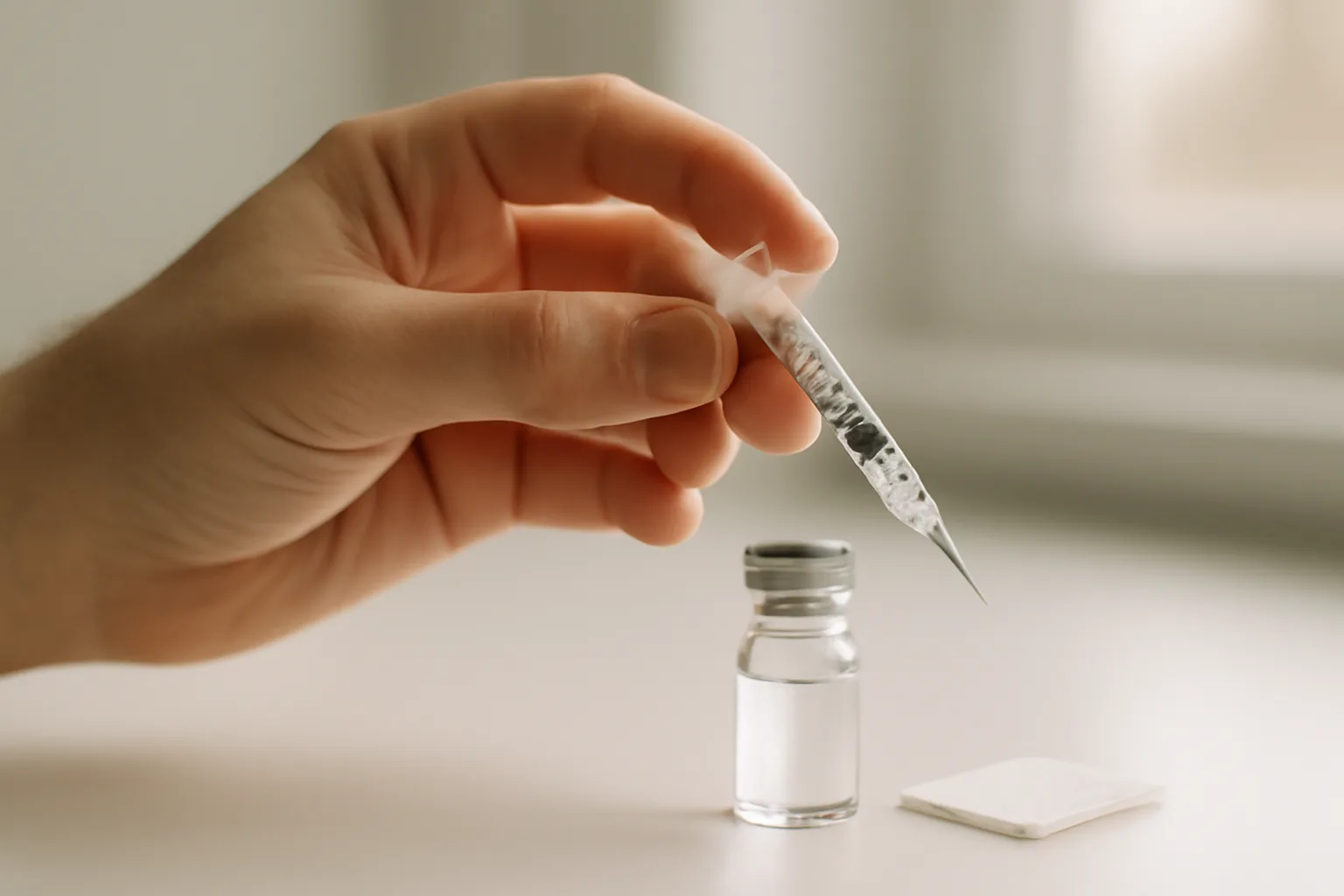
The basic kit is: the reconstituted vial, an insulin syringe with a fine gauge needle (29-31G is standard), alcohol swabs, and a sharps disposal container. You don't need anything exotic. Alcohol swabs go on both the vial's rubber stopper (before you insert the needle to draw up) and on the injection site itself, wiped in a circular motion outward, then allowed to air dry for a few seconds before injecting. Injecting through wet alcohol stings more and doesn't add sterility benefit. A sharps container matters more than people think. Loose needles in household trash are a real needlestick risk to sanitation workers, and most U.S. states have some form of guidance on safe sharps disposal, including mail-back programs and pharmacy drop-off points, detailed by the FDA's guidance on home sharps disposal [5]. Don't just cap and toss a used syringe in the regular trash.
Step-by-step: how do you actually give the injection?
1. Wash your hands. This is the single most important infection-control step and it's the one people skip. 2. Wipe the vial top with an alcohol swab and let it dry. 3. Draw air into the syringe equal to the dose you want, inject that air into the vial (this prevents a vacuum from forming), then invert the vial and draw out your dose. Tap out any air bubbles and push them back into the vial before withdrawing the needle. 4. Pick a site: abdomen, at least 2 inches from the navel, or the outer thigh. Wipe with a fresh alcohol swab and let it air dry. 5. Pinch a fold of skin (this lifts the fat layer away from muscle), insert the needle at 45 to 90 degrees depending on how much fat is at the site and needle length, and push the plunger slowly and steadily. 6. Withdraw the needle at the same angle you inserted it, apply light pressure with a clean gauze or cotton ball, don't rub. 7. Dispose of the needle immediately in a sharps container. Never reuse needles, even on yourself, they dull after one use and reuse raises infection risk. A slight sting or a small bump at the site is common and usually resolves in minutes to hours. Persistent redness, warmth, swelling, or pain that gets worse over a day or two is not normal and should prompt you to stop and think about whether something's contaminated or you're reacting to it.
How is injecting Selank different from the Russian nasal spray studies?
This is the point that gets lost most often, so it's worth being direct: the clinical evidence for Selank, thin as it already is, was built on intranasal administration, not injections. Studies out of Russia's Institute of Molecular Genetics and affiliated researchers tested Selank as a nasal spray in small trials looking at generalized anxiety disorder, mixed anxiety-depression, and cognitive performance under stress, with sample sizes typically in the dozens of patients, not hundreds [2] [6]. That means when someone injects Selank subcutaneously, they're extrapolating a peptide's effects from one route of administration to another, unstudied route. Peptide absorption, bioavailability, and even how much of the peptide crosses into the bloodstream intact can differ meaningfully between intranasal and subcutaneous delivery. Nobody has published data comparing the two for Selank specifically. That's the honest gap: the dosing conventions used by injectors are borrowed loosely from nasal spray studies and adjusted by community trial and error, not derived from injection-specific pharmacokinetic data. This doesn't mean injecting Selank is dangerous or pointless, plenty of peptides are given by injection safely. It means the confidence people project about "the right injectable dose" is higher than what the actual evidence supports.
How good is the Russian evidence on Selank, really?
The honest answer is: modest quality, real but limited quantity, and never replicated by an independent Western research group in a large randomized trial. Selank's core studies were done by Russian teams, largely tied to the Institute of Molecular Genetics of the Russian Academy of Sciences, which also developed the peptide [1]. Sample sizes in the published anxiety trials are small, typically several dozen participants, and many papers are published in Russian-language journals with limited peer review transparency by Western standards. That's different from saying the work is worthless. Some studies show measurable anxiolytic effects on standardized rating scales like the Hamilton Anxiety Rating Scale, and animal studies on Selank's effects on BDNF (brain-derived neurotrophic factor) expression and GABA system modulation offer a plausible mechanism [2] [6]. But "plausible mechanism plus small trials from one research group" is a much weaker evidence bar than what's expected for an FDA-approved anxiolytic in the U.S., where drugs like buspirone or SSRIs went through multi-site, placebo-controlled trials with hundreds to thousands of participants. Russia's regulatory registration of Selank as a pharmacy medicine is also not the same thing as FDA approval. Russian drug registration and the FDA's New Drug Application process use different evidentiary standards, different trial requirements, and different postmarket surveillance systems. Being available by prescription in Russian pharmacies tells you it cleared a domestic regulatory bar, not that it cleared the bar the FDA uses for anxiety medications sold in the U.S. If you want the deeper dive on trial design and what's actually been published, the selank hub page is the place to go next.
Is Selank the same as Semax? People confuse them.
No, they're different peptides with different structures and slightly different reputations, even though they come from the same Russian research lineage and are often sold and discussed together. Semax is a heptapeptide derived from ACTH (adrenocorticotropic hormone), originally developed for stroke recovery and studied for nootropic, cognitive-enhancing effects . Selank is derived from tuftsin and is studied more specifically for anxiety and stress response, though it has some reported cognitive effects too. In practice, people use Semax more for focus and mental clarity and Selank more for anxiety and stress dampening, though there's overlap and some people stack them. Both are nasal-spray-first in the Russian literature, both get injected off-label in the West, and both share the same evidence problem: small Russian studies, no large Western replication. If you're trying to figure out which one actually fits your goal, the semax vs selank and selank vs semax comparison pages break down the practical differences in more detail than makes sense to repeat here.
What side effects or risks come with injecting Selank?
The injection itself carries the standard small risks of any SubQ injection: local redness, minor bruising, a small bump at the injection site, and in rare cases infection if sterile technique isn't followed. These are mechanical risks tied to injecting anything, not specific to Selank's pharmacology. On the peptide's own reported side effect profile, Russian literature and user reports describe Selank as generally well tolerated, with occasional reports of mild drowsiness, nasal irritation (specific to the spray form), or headache [2]. Because Western trials haven't independently verified this safety profile at scale, and because there's no long-term safety data on repeated subcutaneous injection specifically, anyone using it should treat the risk profile as incompletely known rather than settled. For a full rundown of what's reported and what's genuinely unknown, see selank side effects. People on blood thinners, with clotting disorders, or with active skin infections at typical injection sites should be more cautious about any home injection practice, and pregnant or breastfeeding people should avoid any unapproved peptide given the total absence of safety data in those populations.
Where do people get Selank, and does sourcing matter?
Sourcing matters enormously with a compound like this, because Selank sold outside Russia is unregulated as a consumer product. Purity, actual peptide content versus what's on the label, and sterility all vary by supplier, and there's no FDA oversight checking any of it before it reaches a buyer. Third-party certificates of analysis (COAs) from the supplier are the main way to get any independent confirmation of what's actually in a vial, and not every seller provides them. Selank Co works with a provider-reviewed sourcing route and names its fulfilling pharmacy partner rather than compounding or manufacturing anything itself, which is a meaningfully different model from unmarked gray-market vials with no chain of custody. If you're deciding where to source from, the buy selank page walks through what to look for in a supplier and how the provider-reviewed route works in practice.
How do you know if the dose or injection is working?
There's no blood test or biomarker you can check at home to confirm Selank is doing anything. In the Russian trials, effect was measured with anxiety rating scales over days to weeks of use, not a single-dose subjective check [2] [6]. That means a reasonable approach is tracking your own anxiety, sleep, and stress reactivity over a couple of weeks at a stable dose, rather than judging one injection. Some people report a subtle, calmer feeling within an hour or two of a dose, others report nothing noticeable in the short term but say stress reactivity feels different after days of consistent use. Both are plausible given how the mechanism (modulating GABA and enkephalin degradation, per animal studies) would be expected to work gradually rather than as an acute hit [2]. If you notice nothing at all after two to three weeks of consistent dosing within the typical 250-3000mcg range, that's a reasonable point to stop and reassess rather than keep escalating.
Frequently asked questions
Can you inject Selank into a muscle instead of under the skin?
Subcutaneous is the standard route people use, not intramuscular. There's no data showing IM injection improves Selank's effect, and IM injection is more technically demanding and more painful without training. Stick to the fat layer under the skin (abdomen or outer thigh) with a short, thin insulin needle rather than injecting into muscle.
How much bacteriostatic water do you mix with Selank powder?
A common approach for a 10mg vial is 2mL of bacteriostatic water, giving 5mg/mL (500mcg per 10 units on an insulin syringe). Some people use 1mL for a more concentrated 10mg/mL solution. There's no single official ratio, so pick a concentration, do the math correctly, and stay consistent.
Is injectable Selank the same product tested in Russian clinical studies?
No. The Russian studies behind Selank's anxiolytic reputation used an intranasal spray, not injections. Injectable use is a workaround based on what's actually sold as lyophilized powder outside Russia, and there's no published data comparing subcutaneous injection to the nasal route for this peptide specifically.
How often should you inject Selank per day?
Most reported protocols use once or twice daily dosing, generally in the 250-3000mcg per dose range, drawn from Russian clinical use and community practice rather than an FDA-reviewed schedule. There's no strong data pinning down an optimal frequency, so once-daily is a reasonable, conservative starting point.
Does Selank need to be refrigerated after mixing?
Yes. Once reconstituted with bacteriostatic water, Selank should be kept refrigerated and used within roughly 2-4 weeks, a window borrowed from general peptide handling practice rather than a Selank-specific stability study. Keep it away from light and don't freeze it.
What needle size is used for Selank injections?
Standard insulin syringes with 29-31 gauge needles, 4-8mm long, are what's typically used for subcutaneous Selank injection. These are the same fine needles used for insulin and most home-injected peptides, chosen because they're thin, short, and made for shallow SubQ depth.
Is Selank legal to buy and inject in the United States?
Selank isn't FDA-approved for any medical use in the U.S., which means it exists in a gray area, typically sold labeled "for research purposes." It's not a scheduled controlled substance, but buying it for personal injection sits outside FDA-regulated medical use, and quality control depends entirely on the supplier.
What's the difference between Selank and Semax if you're choosing between them?
Selank derives from tuftsin and is studied mainly for anxiety and stress response. Semax derives from ACTH and is studied more for cognitive and stroke-recovery effects. Both come from the same Russian research tradition and share the same limitation: small Russian trials, no large independent Western replication.
Can you dose Selank nasally instead of injecting it?
Yes, and it's actually the route used in the original Russian clinical studies. Nasal spray requires a different formulation than the injectable lyophilized powder most Western buyers get, though some people make DIY nasal sprays from reconstituted powder, which introduces its own sterility and dosing accuracy concerns.
What happens if you inject too much Selank?
There's no established toxic dose threshold from controlled human trials, so "too much" isn't well defined. Reported doses in Russian literature and community use top out around 3000mcg per dose. Going well beyond that without data behind it just means you're in genuinely unstudied territory, not necessarily dangerous, but unverified.
Do you need a prescription to buy Selank in the U.S.?
In Russia, Selank nasal spray requires a pharmacy prescription. In the U.S., where it's sold as an unapproved research compound rather than an FDA-approved drug, there's no prescription framework for it at all, it's simply outside that regulatory system entirely.
How long does it take to feel Selank's effects after injecting?
Some users report a subtle calming effect within one to two hours of a dose, but the clinical studies measured effects over days to weeks of consistent use, not single doses. If you're evaluating whether it's working, track how you feel over two to three weeks rather than judging any single injection.
Sources
- National Center for Biotechnology Information (PubMed), "Selank" PubChem compound record: Selank is a synthetic heptapeptide analog of tuftsin developed in Russia
- Kolyasnikova et al., "Anxiolytic activity of Selank", Bulletin of Experimental Biology and Medicine: Russian clinical studies of Selank used intranasal administration and small patient samples when assessing anxiolytic activity
- American Diabetes Association, "Insulin Injection Technique" clinical guidance: Repeated subcutaneous injection at the same site is a documented cause of lipohypertrophy
- Semenova et al., peptide dosing review, Neuroscience and Behavioral Physiology: Reported Selank dosing ranges in Russian research and clinical use
- Kozlovskaya & Seredenin, "Anxiolytic Semax and Selank peptide preparations" review: Selank studies report effects on GABA system modulation and were conducted primarily by Russian research groups
- National Center for Biotechnology Information (PubMed), Semax mechanism review: Semax is an ACTH-derived heptapeptide studied for cognitive and stroke-recovery effects, distinct from Selank